General Info
Character Creation
You've just started a new game. Might and Magic III gives you a default party — a Knight, a Paladin, a Barbarian, a Robber, a Cleric and a Sorcerer. That party is good enough to finish the game, but it's worth reading this section at least once to learn more about classes, statistics and the like.
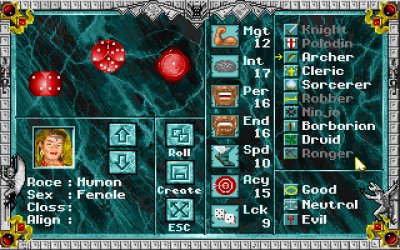
Creating a character is easy. Go to any Inn and check in, then select Create to reach the Character Creation screen. It looks something like this:
Statistics
Seven numbers sit next to icons, each under a three-letter abbreviation. Here's what they mean:
Mgt — Might affects the damage you do when you hit a monster, and is used to bash down doors and the like. Prime statistic for Knights and Paladins.
Int — Intelligence helps determine spell points for Archers, Sorcerers, Druids and Rangers. Prime statistic for those classes.
Per — Personality helps determine spell points for Clerics, Druids, Rangers and Paladins. Prime statistic for those classes.
End — Endurance helps determine hit points. Prime statistic for Paladins, Barbarians and Rangers.
Spd — Speed: everyone, monsters included, has a Speed rating. If yours is higher than the monsters you face, you act first in combat. Prime statistic for Ninjas and Rangers.
Acy — Accuracy helps determine whether you hit a target with a melee or ranged weapon (e.g., a bow). It has no effect on spellcasting (rephrased — editor's note).
Lck — Luck improves your chances of resisting a hostile status spell, avoiding a trap, fleeing a battle or picking a lock. Prime statistic for Robbers.
To the right of the statistics is the list of ten classes. If your prime statistic(s) are high enough for a class, that class is highlighted and selectable. If the class you want isn't highlighted, rearrange your statistics until it is — swap two stats by typing their first letters or clicking their icons. Still can't get it, or just unhappy with your rolls? Click Roll for a fresh random set. You can roll as often as you like, but your previous set is lost forever each time — each roll is independent, so your next set may turn out just as good, worse, or better than the last. So think before you roll. (rephrased — editor's note)
The Ten Classes
Below is each class with the statistics your character-to-be needs to pick it.
Knight — Prime: Might (need 15+). The best fighter in the game. Can use any weapon or armour and deals more damage than anyone. Starts with the Arms Master skill and gains more hit points than any class but the Barbarian. As a pure fighter, casts no spells.
Paladin — Prime: Might, Personality, Endurance (need 13+ in each). A good fighter, though not as strong as the Knight, with somewhat lower hit points. Can use any weapon or armour. Starts with the Crusader skill and can cast Clerical spells.
Archer — Prime: Intellect, Accuracy (need 13+ in both). About as good a fighter as the Paladin. Starts able to cast Arcane spells, but can't wear armour heavier than chain mail or use a shield. No starting secondary skills.
Cleric — Prime: Personality (need 13+). A fair fighter, but can't use edged or missile weapons. Can wear splint mail or lighter, and has twice the Paladin's Clerical spell points. No starting secondary skills.
Sorcerer — Prime: Intellect (need 13+). An extremely poor fighter, limited to padded armour and to staves and daggers. But Sorcerer Arcane spells are the most destructive in the game, with twice the Archer's spell points. Starts with the Cartography skill.
Robber — Prime: Luck (need 13+). An average fighter, limited to chain mail or lighter. Can use almost any weapon and shields, but casts no spells. Begins with the Thievery skill at value 30.
Ninja — Prime: Speed, Accuracy (need 13+ in both). A good fighter, limited to ring mail or lighter and no shield. Uses most (not all) weapons. Begins with Thievery at value 15 and casts no spells.
Barbarian — Prime: Endurance (need 15+). Almost as good a fighter as the Knight, but can't wear armour heavier than scale mail. To compensate, has the most Hit Points and gains extra attacks faster than any class. Uses most weapons and shields. No spells, no starting skills.
Druid — Prime: Intellect, Personality (need 15+ in both). A poor fighter, limited to light armour and weapons, but casts Natural spells with twice the Ranger's spell points. Starts with the Direction Sense skill.
Ranger — Prime: Intellect, Personality, Endurance, Speed (need 12+ in all). The most versatile class. A good fighter who uses most weapons and armour and casts Natural spells (a limited mix of Clerical and Arcane). Excels at nothing in particular but does a bit of everything. Starts with the Pathfinder skill.
This chart shows each class's advantages and disadvantages. HP is hit points gained per level; Attacks is the number of levels needed to gain an extra attack per round.
| Class | HP | Attacks | Skill | Spells |
|---|---|---|---|---|
| Knight | 10 | 5 | Arms Master | — |
| Paladin | 8 | 6 | Crusader | Clerical (half power) |
| Archer | 7 | 6 | — | Arcane (half power) |
| Cleric | 5 | 7 | — | Clerical (full power) |
| Sorcerer | 4 | 8 | Cartographer | Arcane (full power) |
| Robber | 8 | 6 | Thievery 30 | — |
| Ninja | 7 | 5 | Thievery 15 | — |
| Barbarian | 12 | 4 | — | — |
| Druid | 6 | 7 | Direction Sense | Natural (full power) |
| Ranger | 9 | 6 | Pathfinding | Natural (half power) |
The Five Races
Next, choose a portrait — which fixes your race and gender. Click the arrows beside the portrait to change it; pick one matching the race and gender you want. There are two portraits per race/gender combination, so you're essentially forced to build a balanced party. To use a portrait belonging to one of your default characters, you'd first have to delete that character (more on this in the walkthrough).
Humans — Start with the Swimming skill and a small resistance to all spells (value 7 to every element). How resistance works is explained in the General Info section.
Elves — Tall, slender, unusually well suited to magic. Only slightly resistant (value 5 to Energy and Magic). Make very good Robbers, Ninjas, Sorcerers and Archers, but aren't as tough as other races and tend to have fewer hit points.
Dwarves — Short but very tough. Slightly resistant to most spells, but especially to acid and poison (value 5 vs Fire, Cold, Electricity and Energy; value 20 vs Acid/Poison). Make great Robbers and good Knights or Barbarians. Begin with the Danger Sense skill.
Gnomes — Smaller than dwarves and not as tough. Good spell casters, but tend to have fewer hit points than every race except Elves. Begin with the Spot Secret Doors skill. Resistance is only value 2 to everything except Magic, which is value 20.
Half-Orc — A cross between Human and Orc. The toughest playable race, but also the dimmest — excellent Knights and Barbarians, the worst spell casters and Robbers. Resistance value 10 vs Fire, Cold and Electricity.
This chart explains each race. HP and SP are the per-level modifiers to hit points and spell points; Thievery is the initial bonus/penalty to the Thievery rating (if the character is a Robber or Ninja). Resistance abbreviations: F = Fire, C = Cold, E = Electricity, P = Acid/Poison, N = Energy, M = Magic.
| Race | HP | SP | Thievery | Resistance | Skills |
|---|---|---|---|---|---|
| Human | 0 | 0 | 0 | 7 F, 7 C, 7 E, 7 P, 7 N, 7 M | Swimming |
| Elf | -2 | +2 (*) | +10 | 5 N, 5 M | — |
| Dwarf | +1 | -1 | +10 | 5 F, 5 C, 5 E, 20 P, 5 N | Danger Sense |
| Gnome | -1 | +1 | +5 | 2 F, 2 C, 2 E, 2 P, 2 N, 20 M | Spot Secret Doors |
| Half-Orc | +2 | -2 | -10 | 10 F, 10 C, 10 E | — |
(*) An Elf only gets the +2 Spell Point bonus if he/she is an Arcane spell user.
Gender makes no difference — male and female characters are equally strong.
With statistics, race and class set, choose an alignment: Good, Neutral or Evil. It generally makes little difference and comes down to preference, though a few occasions tie your reward or punishment to alignment (flagged in the walkthroughs). Finally, click Create, enter a name, and your character is ready to join the party.
Party-Building Pointers
It's entirely up to you which characters you create (if any — you can keep the default party instead), but if you build your own:
Take at least one Robber or Ninja. There are many locked doors and treasure chests that are very hard to open without the Thievery skill — and the best loot is usually inside chests.
Have at least two characters with high Might, placed at the front. This makes bashing through doors, gates and walls much easier.
Build the party so you have access to all three forms of magic — Arcane, Clerical and Natural. Arcane is the best (sometimes only) way to beat some tough enemies; Clerical is needed constantly for healing (potions just don't cut it); Natural is a balanced mix that also brings spells the others lack, including Walk on Water — which you'll badly miss later if you don't have it. (Note: the default party has no Natural magic user.)
There are eight party slots, but the last two are reserved for hirelings — so create at most six characters.
You can create new characters later, but each starts at level 1. Build a good party up front and stick with it — don't underestimate the importance of character creation.